judaism


Sleep deserts my eyes and I toss like a

ship in the sea of my yearning for You

as I imagine these things: If I were an

infant and you were my nurse, I would

suckle your beautiful breasts, and

quench my thirst. If I were a stream

and you and I sat in the shade of my

garden, I would loook after your fruit.

If I was a spear and you thrust me

into your enemies’ hearts, I would be

drunk with their blood. If I were a tent

and you dwelt in me, we would delight

ourselves with love and clothe ourselves

with joy. If I were a tongue and you

were my words, I would soothe desire’s

flame with a song. If I were a slave and

you were my lord, I would long to

serve you, I would never choose

freedom.

Israel ben Moses Najara (c. 1555, Damascus – c. 1625, Gaza) (Heb. ישראל בן משה נאג’ארה Yisrael ben Moshe Najarah) was a Jewish liturgical poet, preacher, Biblical commentator, kabbalist, and rabbi of Gaza.

According to Franco (Histoire des Israélites de l’Empire Ottoman,
p. 79, Paris, 1897), there is another account which declares that
Najara was born about 1530 and that he lived for some years at Adrianople. From his secular poems, which he wrote in the meters of various Turkish, Spanish, and modern Greek songs, it is evident that he knew well several foreign languages. He travelled extensively in the Near East, had lived in Safed, where he came under the extensive influence of Lurianic Kabbalah and served as a rabbi at the Jewish community of Gaza.

As may be seen from his works, he was a versatile scholar, and he corresponded with many contemporary rabbis, among others with Bezaleel Ashkenazi, Yom-Ṭob Ẓahalon, Moses Hamon, and Menahem Ḥefeẓ. His poetic effusions were exceptionally numerous, and many of them were translated into Persian. While still young he composed many religious hymns, to Arabic and Turkish tunes, with the intention, as he says in the preface to his Zemirot Yisrael, of turning the Jewish youth from profane songs. He wrote piyyuṭim, pizmonim, seliḥot, widduyim, and dirges for all the week-days and for Sabbaths, holy days, and occasional ceremonies, these piyyuṭim being collected in his Zemirot Yisrael. Many of the piyyuṭim are in Aramaic.

For his hymns on the marriage of God and Israel, Najara was severely blamed by Menahem Lonzano (Shete Yadot, p. 142) when the latter was at Damascus. The Shibḥe Ḥayyim Wiṭal (p. 7b) contains a violent attack by Ḥayyim Vital upon a poet whose name is not mentioned, but who some take to be Israel Najara. Nevertheless, Isaac Luria, Vital’s teacher, declared that Najara’s hymns were listened to with delight in heaven. His piyyuṭim were praised also by Leon of Modena, who composed a song in his honor, which was printed at the beginning of the Olat Shabbat, the second part of the Zemirot Yisrael.

He is buried in the ancient Jewish cemetery in Gaza. His son, Moses Najara was also a poet, who succeeded his father as the chief rabbi of Gaza.

http://en.wikipedia.org/wiki/Israel_ben_Moses_Najara

Sing To The Eternal

The Penguin Book of Hebrew Verse (Penguin Classics)

I praise the Lord, Prince of the realm and King!

His rule extends across the whole wide world.

Gweir was penned beneath the fortress mound,

As tell the tales of Pwyll and Pryderi.

None before him passed into the prison,

With a heavy chain a faithful servant bound.

Bitter before the spoils of Annwn he sang,

And until Doomsday lasts our bardic prayer.

Three companies of warriors we went in –

Seven alone rose up from Elfs-castle.


Song rang out, honoring me with praise

In the four-peaked fortress, four its mighty turnings.

My verses from within the cauldron uttered,

By breath of maidens ninefold they were kindled.

The lord of Annwn’s cauldron: how is it made?

A dark ridge on its border, crusted pearls.

Its fate is not to boil the meat of cowards,

The deadly flashing sword is lifted to it,

And in the hand of the Leaper it was left.

Before the doors of hell the lamps were burning.

When we went in with Arthur, blinding trouble –

Seven alone rose up from Meads-castle.


Song rang out, honoring me with praise

In the four-peaked fortress, isle of the strong door.

Flowing water and shining jet are mingled,

They drink the sparkling wine before their followers.

Three companies of warriors sailed the sea –

Seven alone rose up from Hard-castle.


I do not deserve to be put with poetasters:

Beyond the fort they missed the valor of Arthur.

Six thousand men stood on the glass wall,

Their sentinel was difficult to speak with.

Three companies of warriors went with Arthur –

Seven alone rose up from Guts-castle.


I do not deserve the mean men, slack their shield straps.

They do not know the day of our creation,

Nor what time of day the One was born.

Who made him who strayed far from Defwy meadows?

They do not know the ox, his thick headband,

Full sevenscore links upon his chained collar.

And when we went with Arthur, woeful visit –

Seven alone rose up from Gods-castle.


I do not deserve these men — slack their will.

They do not know which day the chief was sired,

Nor what hour of day the lord was born,

Nor what beasts are kept, their heads of silver.

When we went in with Arthur, sorrowful strife –

Seven alone rose up from Box-castle.


Monks are a pack together — a choir of dogs –

They shrink away from meeting the lords who know:

Is there one course of wind? One course of water?

Is there one spark of fire?  Of fierce tumult?

Monks are a pack together, like youngling wolves

They shrink away from meeting the lords who know:

They do not know when night and dawn divide,

Nor wind, what is its course, nor what its onrush,

What place it ravages, nor where it strikes.

The grave of the saint vanishes, grave and ground.

I praise the Lord, great Prince of the whole world,

And so I am not sad, for Christ endows me.

further:

http://www.lib.rochester.edu/camelot/annwn.htm

http://en.wikipedia.org/wiki/Preiddeu_Annwfn

http://igerne.tripod.com/annwn.htm

http://www.celtic-twilight.com/camelot/poetry/taliesin/spoils_annwfn.htm


In the center of the Castle of Brahma, our own body, there is a small shrine,

in the form of a Lotus flower, and within can be found a small space.

We should find who dwells there and want to know him….

for the whole universe is in him and he dwells within our heart.

–Chandoga Upanishad


Or, as one might say; In the center of the Castle of the Grail, our own body, there is a shrine,

and within it is to be found the Grail of the Heart.

We should indeed seek to know and understand that inhabitant.

It is the fragment of the divine contained within each one of us- like the sparks of

unfallen creation which the Gnostics saw entrapped within the flesh of the human envelope.

This light shines within each one, and the true quest of the Grail consists in

bringing that light to the surface, nourishing and feeding it until its radiance suffuses the world.

–John Matthews (“Temples of the Grail” found in At The Table of the Grail: No One Who Sets Forth on the Grail Quest Remains Unchanged )


The Grail Mystery Returned underground, wrapped itself again in its esotericism

and waited for another time toi unfold its inner revelation. Such a point was reached

after the Reformation, when the inner Grail mystery…surfaced again in the Rosicruccian

movement of the early seventeenth century. At this time…the Rosicrucians tried to incarnate

an Esoteric Christianity within the Protestant movement…in order to provide a much needed

resolution of the polarities of Protestantism. Thus we should see the Rosicrucian

movement as being inwardly related to the Grail mystery. The spiritual alchemy that

was the esoteric foundation of Rosicrucianism can be seen as a development of the Grail impulse.

–Adam Maclean (“Alchemical transmutation in history and symbolism” , found in At the Table of the Grail 1982)


The

intrinsic definition of Limitlessness is that It lacks nothing and can

receive nothing, for It is everything. As It is everything,

theoretictically It is the potential to be an infinite source of giving.


The

question arises, however, that there is nothing for It to give to

because It is everything. It would have to give to Itself. This has been

a major creation. conundrum in philosophy and theology for thousands of

years.


Kabbalah

suggests one way of dealing with this issue. It says that as long as

the infinite source of giving has no “will” to give, nothing happens.

However, the instant It has the will to give, this will initiates a

“thought.” Kabbalah says, “Will, which is [primordial] thought, is the

beginning of all things, and the expression [of this thought] is the

completion.


That is, the entire creation is nothing more than a thought in the “mind” ofEin Sof, so

to speak. Another way to express this idea is that the will to u give

instantly creates a will to receive. The idea that an infinite giver can

create receptivity in Itself is what Kabbalists call tzimtzum (contraction). It has to make an opening within Itself for receiving.


That which is given is called light. That which receives is called vessel. Light

and vessel are always in balance, because light comes from an infinite

source and thus will fill a vessel to its capacity. If we put a bucket

under Niagara Falls, it instantly fills. If we put a freight train

there, it also instantly fills. Imagine that the entire universe rests

under a Niagara Falls of light, continuously being filled.


According

to Kabbalah, the interaction between vessel and light is what makes the

world go around. Everything in the universe is a vessel that “wills” to

receive the light of theinfinite bestower. Each molecule, plant,

animal, rock, and human is a vessel; each has the “will” to be exactly

what it is.]


Human

consciousness is unique in that it has the quality of being “in and the

universe. If we the image of God.” This quality is expressed by what we

call free will, and free will at its core is nothing more than the

ability to bestow light. That is to say, human consciousness has an

inherent will to give. This human capability of acting like God in being a bestower is the fulcrum upon which the entire universe is balanced.


The

reason this is so important is that if there were a will only to

receive, as described above, the universe would be completely

predictable. Everything would be predetermined, all receptivity would

find shape in its implicit design, and every aspect of the unfolding of

creation could be anticipated. The wild card introduced here is the

premise that human consciousness is informed by a soul force that gives

it the capacity to emulate the infinite Bestower.


Thus

human beings have an extraordinary capacity to influence the direction

of creation. Each time we make use of our free will by giving, we are in

copartnership with the infinite Bestower. When this is accomplished,

with clear awareness of what we are doing, we raise the consciousness of

creation.

–David A Cooper (God Is a Verb: Kabbalah and the Practice of Mystical Judaism)

Out beyond ideas

of wrongdoing and rightdoing,

there is a field.

I’ll meet you there.

..

When the soul lies down

in that grass,

the world is too full to talk about.

Ideas, language

- even the phrase “each other” -

do not make any sense.

–Rumi


“In some ways kavannah
is similar to the Buddhist notion of mindfulness, for kavannah, like
mindfulness, is understood to mean attention and intention. One intends
to place one’s attention on what is going on all around one…..

In Roptchitz, where
the tzaddik Naftali lived (a tzaddik is

a fully enlightened being), it was the custom for rich people whose

houses stood isolated to hire men to watch over their property by night.

Late one evening Naftali was skirting the woods that surrounded the

city and meditating on the moon when he encountered a watchman.

‘For whom are you
walking?’ the tzaddik asked.

Not recognizing him,
the watchman inquired in turn, ‘For whom are you working Rebbe?’

The words struck the tzaddik
like an arrow.

‘I am not working for anybody just yet,’ he whispered and began walking

back and forth in great agitation and whispering to himself, ‘For whom

am I working, for whom am I working?’ Finally he stopped and turned to

the watchman. ‘Will you come and work for me?’ he asked.

The watchman asked,
‘But what would be my duties?’

‘To remind me,’
murmured the tzaddik.

This story
illustrates the kind of attention necessary for our practice. The tzaddik,
already enlightened, recognizes that his attention could be even more sharply
focussed…..

Kavannah is to place our
attention on what we are doing, then, by being in the moment, we experience joy
in the doing…..

Our kavannah,
our passionate intent, brings

us into deeper contact with all of life, even the painful parts. For if

we wall ourselves off from life because we believe that life is

suffering and filled with pain, we will end up walling ourselves away

from the joy and infinite sweetness of existence, and we will thus

barricade the direct road to wisdom and enlightenment.”

The Way of Flame: A Guide to the Forgotten Mystical
Tradition of Jewish Meditation


“The sum-total
of human suffering all round must be

incredible, and yet it seems to be considered quite a normal condition

in this world, as long as it is happening to somebody else……The only

possible hope for this world is to alter the SOUL of humanity

for the better, which may be a small step for us, but an important one

nevertheless. I suppose in the end we all have our ideas of what to do

for the best, but what is important is that we should want to do better

in the first place.”

- J.G. Swart


Where your thought is,
is precisely where you are
all of yourself is there.


–Rabbi Yisrael Baal Shem Tov

My love
washes her clothes in the water

of my tears
and spreads them out in the

sun of her
beauty. She has no need of

spring-water
- she has my two eyes;

not of the
sun – she has her own

radiance


–Judah Halevi

The Penguin Book of Hebrew Verse (Penguin Classics)

Judah Halevi (also Yehuda Halevi; Hebrew: יהודה הלוי; c. 1075 – 1141) was a

Spanish Jewish physician, poet and philosopher. He was born in Spain, either in

Toledo or Tudela[1], in 1075[2]
or 1086, and died shortly after arriving in the Land of Israel in 1141.
Halevi is considered one of the greatest Hebrew poets, celebrated both
for his religious and secular poems, many of which appear in present-day
liturgy. His greatest philosophical work was The Kuzari.

The Western mind focuses on substance; the Eastern mind focuses on the interrelationship between everything. Nothing has independant being in of itself. That’s the basic insight of sunyata, whereas in Western mysticism, nothingness is still the ultimate essence. It may be pure Divine being, but it is also something. The East would criticize even this ultimate substance or essence and try to see through the illusion that there is any existent thing in and of itself.

You could say that there are two ways of describing an underlying reality that, presumably, is one and the same. But whereas sunyata is central to Buddhism, most Jews have never heard of Ayin. Even in Kabbalah, it’s talked about very rarely. In Hasidism, it’s further developed, but of all the Hasidic teachers, maybe one percent is devoted to ayin.

Yet, ayin is central because it represents the moment of transition from infinity (Ein Sof) to the sefirot. Ayin is how God unfolds. Creation is rooted in nothingness. There are roots for this postive sense of nothingness within Judaism. The Talmud, for example states, “The words of Torah do not become real except for one who makes himself as if he is not.” Job asked rhetorically, “Where is wisdom to be found?” The word ayin in this verse is in question: “where?” But already in the Talmud, ayin is interpreted as a noun: “Wisdom is found in nothingness.” In Kabbalah, it becomes Divine nothingness. Its roots lie in rabbinical literature, but Kabbalah expands this.

–”Why meditate?” by Daniel C Matt

 Meditation from the Heart of Judaism: Today’s Teachers Share Their Practices, Techniques and Faith

In all change and growth, say the masters, the mysterious ayin is present. There is an ungraspable instant in the midst of all transformation when that which is about to be transformed is no longer that which it had been until that moment, but has not yet emerged as its transformed self; that moment belongs to the ayin within God. Since change and transformation are constant, however, in fact all moments are moments of contact with the ayin, a contact that man is usually too blind to acknowledge. The height of contemplative prayer is seen as such a transforming moment, but one that is marked by awareness. The worshiper is no longer himself, for he is fully absorbed, in that moment, in the Nothingness of divinity. In that moment of absorption the worshiper is transformed: as he continues his verbal prayer, it is no longer he who speaks, but rather the Presence who speaks through him. In that prayerful return to the source, the human being has reached his highest state, becoming nought but the passive instrument for the ever self-proclaiming praise of God. Through his lips the divine word is spoken.

–Arthur Green, Your Word Is Fire: The Hasidic Masters on Contemplative Prayer (A Jewish Lights Classic Reprint)

If you are a poet, you will see clearly that there is a cloud floating in this sheet of paper. Without a cloud, there will be no rain; without rain, the trees cannot grow; and without trees, we cannot make paper. The cloud is essential for the paper to exist. If the cloud is not here, the sheet of paper cannot be here either. So we can say that the cloud and the paper inter-are. “Interbeing” is a word that is not in the dictionary yet, but if we combine the prefix “inter-” with the verb “to be,” we have a new verb, “inter-be.” If we look into this sheet of paper even more deeply, we can see the sunshine in it. Without sunshine, the forest cannot grow. In fact, nothing can grow without sunshine. And so, we know that the sunshine is also in this sheet of paper. The paper and the sunshine inter-are. And if we continue to look, we can see the logger who cut the tree and brought it to the mill to be transformed into paper. And we see wheat. We know that the logger cannot exist without his daily bread, and therefore the wheat that became his bread is also in this sheet of paper. The logger’s father and mother are in it too. When we look in this way, we see that without all of these things, this sheet of paper cannot exist. Looking even more deeply, we can see ourselves in this sheet of paper too. This is not difficult to see because when we look at a sheet of paper, it is part of our perception. Your mind is here and mine is also. So we can say that everything is in here with this sheet of paper. We cannot point out one thing that is not here–time, space, the earth, the rain, the minerals in the soil, the sunshine, the cloud, the river, the heat. Everything co-exists within this sheet of paper. That is why I think the word “inter-be” should be in the dictionary. “To be” is to inter-be. We cannot just be by ourselves alone. We have to inter-be with every other thing. This sheet of paper is, because everything else is.

Suppose we try to return one of the elements to its source. Suppose we return the sunshine to the sun. Do you think this sheet of paper will be possible? No, without sunshine nothing else can be. And if we return the logger to his mother, then we have no sheet of paper either. The fact is that this sheet of paper is made up only of “non-paper” elements. And if we return these non-paper elements to their sources, then there can be no paper at all. Without non-paper elements–like mind, logger, sunshine and so on–there will be no paper. As thin as this sheet of paper is, it contains everything in the universe in it.

–Thich Nhat Hanh, Is Every Step: The Path of Mindfulness in Everyday Life

God, the word evokes such a lot. In Buddhism however we find that God is as you say, transcendant, but if we dig deeper God is also immanent.

We see this clearly in:

1

The tao that can be told
is not the eternal Tao
The name that can be named
is not the eternal Name.

The unnamable is the eternally real.
Naming is the origin
of all particular things.

Free from desire, you realize the mystery.
Caught in desire, you see only the manifestations.

Yet mystery and manifestations
arise from the same source.
This source is called darkness.

Darkness within darkness.
The gateway to all understanding.

…………………

This is the ineffible, unknowable reality above reality, beyond reality, something outside of words, outside of concepts…

This is the “God” of the Kabbalist, (Ain Sof: endless light)
This is the God of the mystic (christian and otherwise) such as Meister Eckhart

“To be full of things is to be empty of God. To be empty of things is to be full of God.”

The Kabbalist (Jewish Mystic, for sake of argument) states ideas such as:

The Nature of God

(from “God is a Verb” by David A. Cooper)


“What is God? In a way, there is no God. Our perception of God usually leads to a misunderstanding that seriously undermines our spiritual development.
God is not wht we think It is. God is not a thing, a being, a noun. It does not exist, as existence is defined, for It takes up0 no space and is not bound by time. Jewish mystics often refer to It as Ein Sof, which means Endlessness.


Ein Sof should never be conceptualized in any way. It should not be called Creator, Almighty, Father, Mother, Infinite, the One, Brahma, Buddhamind, Allah, Adonay, Elohim, El, or Shaddai, and It should never, never be called He. It is none of these names, and It has no gender.


When we call It God, what are we talking about? If we say that It is compassionate, full of lovingkindness, the source of love, we may be talking about our image of what we think the divine nature ought to be, but we are not talking about Ein Sof. In the same way, if we say that the God portrayed in the Bible is vindictive, jealous, angry, cruel, uncaring, or punitive, we cannot be referring to Ein Sof. Ein Sof includes every attribute but cannot be definite by any of them individually or all of them combined…..


The idea of Ein Sof was first described by the twelfth-century Kabbalist, Isaac the Blind. He taught that Ein Sof precedes thought (machshavah), and it even precedes the Nothingness (ayin) out of which thought is born. Nothingness is viewed as a level of awareness that is the result of the ‘annihilation of thought.’


The idea of the annihilation of thought, of course, is paradoxical. Can we imagine a void without beginning or end? Can we, limited by minds that are finite, imagine infinity? The answer is no, we cannot think of Nothing. Anything that we can imagine has some kind of boundary—Kabbalists call it garment or vessel—and boundaries are containers. All thoughts, including all imagination, are garments or vessels.


By definition, a boundary sets limits. We may be able to put a name to infinity, we can draw a symbol of a figure eight on its side and say that this represents infinity, but no matter how much we may believe that our imagination is limitless, we remain confined by the boundaries of our own reality. If it can be imagined, it is not infinite.


As infinity is beyond the imagination, what about that which transcends infinity—that which created it? Ein Sof is not ‘restricted’ by infinity. Indeed, we have suddenly run out of words because the idea of ‘trans-infinite’ is a logical absurdity. What can go beyond infinity? Moreover, what can go beyond the Nothingness that surrounds infinity? This is Ein Sof.


Although we are informed that Ein Sof is inaccessible through any intellectual endeavor, we may still ask if there is a ‘knowing’ that surpasses the intellect. Did Isaac the Blind have access to a level of awareness through which he could sense, somehow, the imperceivable?


The answer is yes. Jewish mysticism teaches that we can know Ein Sof in ways that transcend thought. This aspect of developing a relationship with Endlessness, the source of creation, is the key to all Kabbalah and the lifeblood of all Jewish practice. The secret teaching in developing this relationship with the Unknowable is hidden in the mystical foundation of the nature of relationship itself.


The word ‘God,’ and each of Its various names in Judaism, such as El, Elohim, Adonoy, Shaddai, and so forth, represent aspects of Ein Sof. The exploration of these aspects gives us insight into the nature of Ein Sof . Thus, whenever God is discussed…..we are not talking about a thing in itself, but a representation of a far deeper mystery…..


We can relate to God as an interactive verb. It is God-ing…..Many names of God are included in Ein Sof; God-ing is one name—a name that happens to be a verb rather than a noun…..What would we be without the awesomeness of the unknowable God?
There is no answer to this question; we cannot prove anything about Ein Sof. Rahter, it is a self-reflecting inquiry. Yet when viewed from the perspective of our dynamic relationship with the Divine, it is a self-fulfilling question, for paradoxically the source of the question is the answer it seeks. ‘What would I be without God?’
Consider this question from your inner awareness. Not you the noun, the person you may think you are, but you the verb, the process of being in full relationship, continuously, with its creator. When a question arises wthin you, who is asking the question, and to whom is the question addressed? Assume that there is no ‘me’ to ask the question, and there is no God out there to answer it. The question is part of the process of David-ing and God-ing in a mutual unfolding.


Try to do this in a way that melts all barriers or separation. No subject and no obuect. Simply an ever-opening process. No past, no future; only the Now. Each moment is a fresh opening. Each breath we draw, each move we make, is only Now. This is my dance with God-ing. It is an awesome experience…..


Perhaps you will take a few moments to close your eyes and allow yourself to sink into this idea. Meditate on this thought: The teaching of the mystery of Ein Sof is that the center of our being, out of which awe arises, is that about which we are awed. It is It! When we contemplate our continuous process of opening, right here, right now, we realize that God-ing is always with us…..


The Unknowable can be discerned. Beginning at an indefinable point as sharp as a needle. It radiates in various ways which can be perceived—only in the context of process and interaction. We are not an audience watching the God-ing process onstage. We are onstage, ourselves. We mysteriously begin to get a glimmer of God-ing when we succeed in merging with the continuous process of unfolding creation…..


The intrinsic definition of Limitlessness is that It lacks nothing and can receive nothing, for It is everything. As It is everything, theoretically It is the potential to be an infinite source of giving.


The question arises, however, that there is nothing for It to give to because It is everything. It would have to give to Itself. This has been a major conundrum in philosophy and theology for thousands of years.


Kabbalah suggests one way of dealing with this issue. It says that as long as the infinite source of giving has no ‘will’ to give, nothing happens. However, the instant It has the will to give, this will initiates a ‘thought.’ Kabbalah says, ‘Will, which is [primordial] thought, is the beginning of all things, and the expression [of this thought] is the completion.’


That is, the entire creation is nothing more than a thought in the ‘mind’ of Ein Sof, so to speak. Another way to express this idea is that the will to give instantly creates a will to receive…..”

ain

Here we can see that God is NOT God

If we return to Buddhism the Heart Sutra states:

Body is nothing more than emptiness,
emptiness is nothing more than body.
The body is exactly empty,
and emptiness is exactly body.

The other four aspects of human existence –
feeling, thought, will, and consciousness –
are likewise nothing more than emptiness,
and emptiness nothing more than they.

All things are empty:
Nothing is born, nothing dies,
nothing is pure, nothing is stained,
nothing increases and nothing decreases. So, in emptiness, there is no body,
no feeling, no thought,
no will, no consciousness.
There are no eyes, no ears,
no nose, no tongue,
no body, no mind.

There is no seeing, no hearing,
no smelling, no tasting,
no touching, no imagining.

There is nothing seen, nor heard,
nor smelled, nor tasted,
nor touched, nor imagined.

There is no ignorance,
and no end to ignorance.
There is no old age and death,
and no end to old age and death.
There is no suffering, no cause of suffering,
no end to suffering, no path to follow.
There is no attainment of wisdom,
and no wisdom to attain.

The Bodhisattvas rely on the Perfection of Wisdom,
and so with no delusions,
they feel no fear,
and have Nirvana here and now. +

All the Buddhas,
past, present, and future,
rely on the Perfection of Wisdom,
and live in full enlightenment.
The Perfection of Wisdom is the greatest mantra.
It is the clearest mantra,
the highest mantra,
the mantra that removes all suffering.

………..
Here we see the Heart Sutra telling us that God is transcendent and immanent, that God is not God

If we return to christianity again:

Gather up the fragments that remain, that nothing be lost.’

--John 6:12

“But if by “God“ we mean a reality far surpassing our own fullness of being we must envisage the divine as total realization, abundance of life and actuality, energy unfailing, of which our mode of being is a pale reflection, and at best a symbol. Yet people persist in asking whether or not God exists. As Dostoyevsky pointed out, their question never finds an answer, because it is wrongly put. Its proper context is the experience of active loving, but it is confined within the narrow limits of a notion of existence which is as irrelevant to life as it is unreal and reductionist. The concept of God as a remote entity which does nothing served as a postulate for some philosophers of the eighteenth century, but it is foreign to all the great religious traditions of humankind. For these the question-and it is a burning question-is not of God‘s existence but of his presence, and this implies his power or energy. Yet even today deism is not dead. The reductionist notion of God, which was formerly the preserve of academics, is uncritically accepted by ordinary people in our society, who on the whole do not reject belief that God exists but have little sense of the divine presence and of communion with him. This reductionist point of view is in direct opposition to the religious instinct and mystical impulse, which suffers widespread atrophy in our times.
In spite of all this, the human heart senses that “God” is not a mono­syllabic blob but the Ever-present One. How are we to understand, and live, this sense? Christianity is sometimes seen as nothing but a collec­tion of moral duties and soothing reassurances about salvation, rather than as a summons to the deification of the human person.

St. Athanasius of Alexandria, a pillar of orthodoxy during the fourth century, insisted upon the divine being’s exuberance. The divine being, ineffably more alive that we are, cannot be self-contained and barren but has to be Father, forever bringing forth his son from the womb of his own substance. This continual begetting is a movement of being which is essentially fruitful. Our human experience of parenting is only an analogy for the perfect generation in the divine being, where there is no before and after, no differentiation into male and female, and where the one brought forth is not inferior to the parent. This vision of God continually pouring forth his very being would inspire Meister Eckhart a millennium later to speak of God in terms of molten metal which is always boiling over. The son‘s coming forth from the Father is a non-stop act of both begetting and giving birth.
Thus for the Christian tradition the divine reality is essentially per­sonal. The three are not merely aspects of some impersonal substrate, nor are they separate individuals. The doctrine of the Trinity states that ultimate reality is a communion of persons, each dwelling in the others. Here relationship is of the essence. And this communion of persons is the truth and exemplar of all being. In particular it is the hope to which we human beings aspire. We come alive when our eyes meet those of the one who loves us, for we then find our center outside ourselves in the other, and in so doing we touch the mystery of transcendence.

By falling in love we leave behind our own isolation and break away from our old, limited way of life, which is now revealed as loneliness and incompletion. And, even more, in the unromantic daily struggle of active loving, in relationship, we find out who we really are. That is the context in which we can ask about God for it is then that we most resemble God. The Trinity goes beyond both solitude and the mutual opposition of Dual­ism, for God, as St. John says, is love.”

-–father symeon burholt

….

And finally we get a clear idea if we turn to Gnosticism, and the Gospel of Philip (note that of course many Gnostics were highly influenced by Buddhism, in fact one branch even boasts that their leader was the reincarnation of Lao Tzu)

Light and Darkness, life and death, right and left, are brothers of one another. They are inseparable. Because of this neither are the good good, nor evil evil, nor is life life, nor death death. For this reason each one will dissolve into its earliest origin. But those who are exalted above the world are indissoluble, eternal.

Names given to the worldly are very deceptive, for they divert our thoughts from what is correct to what is incorrect. Thus one who hears the word “God” does not perceive what is correct, but perceives what is incorrect. So also with “the Father” and “the Son” and “the Holy Spirit” and “life” and “light” and “resurrection” and “the Church (Ekklesia)” and all the rest – people do not perceive what is correct but they perceive what is incorrect, unless they have come to know what is correct. The names which are heard are in the world [...] deceive. If they were in the Aeon (eternal realm), they would at no time be used as names in the world. Nor were they set among worldly things. They have an end in the Aeon.

One single name is not uttered in the world, the name which the Father gave to the Son; it is the name above all things: the name of the Father. For the Son would not become Father unless he wore the name of the Father. Those who have this name know it, but they do not speak it. But those who do not have it do not know it.

We see things as we are
Not as they are

–Kahlil Gibran

There are no mundane things outside of Buddhism,
and there is no Buddhism outside of mundane things.

–Yuan-Wu

It is I who am you, and it is you who are me. And wherever you are, I am there.

And I am sown in all; and you collect me from wherever you wish.

And when you collect me, it is your own self that you collect.

–Attributed to Christ, found in the Gospel of Eve

Well some would say Sufism came before Islam, it certainly has its roots prior to Mohammed.

Sufis of course are entrenched in Islam. No real serious Sufi would renounce Islam, its tenets or burn the Qur’an.

Islam of course often finds problems with Sufism and accuses it of not being monotheistic enough and of course Sufis have supposedly often dealt with the Djinn.

SO what we have here is the usual esoteric and exoteric struggle.

The exoteric (for the many) denies the esoteric (for the few)

We find this in Christianity, mainstream Christians often run screaming from any form of Mysticism and contemplation. Christianity of course has a long standing history of this

Judaism has oral torah or Kabbalah as it is often known. This esoteric path of unification with the divine has been seen as blasphemy, occultic and full of naughty things that more exoteric religious and non religious Jews run screaming from. Of course stories such as the Golem do not help the esoteric “cause”

So we find in Islam exactly the same dilemma.

Of course then we also find people that embrace the esoteric but think they need to distance themselves from the exoteric. With investigation one will find that the esoteric is entrenched and a part of the exoteric. The two are inseparable and are one living body. The esoteric thus becomes a deeper part or deeper understanding of the exoteric, kind of like what is below the surface on an ice berg.

Thus the exoteric often denies the esoteric. The esoteric really has no need to do this. Mainly as it approaches the ultimate truth, and understanding that God transcends any religion… and that Islam, Christianity and Judaism are meaningless words.

So IS Sufism a part of Islam?

Yes

“I believe in the religion
Of Love
Whatever direction its caravans may take,
For love is my religion and my faith.”

–Ibn ‘Arabi

Academic Nonsense, Science, and Torah


by


Gershon Winkler


It was recently brought to my attention that a respected so-called Old Testament scholar and author in The Netherlands recently made an earth-shattering discovery that she will be presenting at Radboud University in The Netherlands. Wow. What a discovery. She claims that the first sentence in the Book of Genesis “In the beginning God created the Heaven and the Earth” is not a true translation of the Hebrew. (No kidding! We don’t translate it that way, either!)  Rather, she has done some “fresh textual analysis” that suggests that the great book never intended to imply that God created the world. Actually, she says, the Earth was already in place when God made humans and animals. Someone else must have created the universe itself long before God came on the scene and added a couple of people and animals and a shrub or two. She derives all this from her analysis of the etymology of the Hebraic word “bara,” customarily translated as “created.” It doesn’t really say that, she claims. “Bara” she insists, means to “spatially separate” and if you read the first line of Genesis with that translation, she posits, you will realize that God only spatially separated the heavens and the earth, which in turn implies that the heavens and the earth were already extant and that God only added a few features to what was already there as opposed to having created the universe from scratch, ex-nihilo (The Telegraph [UK], October 8, 2009).


        Mind-blowing. I have been up all night trying to understand her theory and how it proves anything but the sad state of academia. Scholars who have no idea of the vernacular or intention of our Torah have for centuries been drawing theories about its content and have had the audacity as well to present their “findings” at international scholarly conferences. Perhaps I might compose a definitive critique of the science of Neuropsychology since I am totally unlearned in that field, and present it to some Conference on Psychiatry in Vladivostok. Not being a historian, I might also write a thesis about American History, that George Washington is a myth invented in the early 20th century to boost patriotism in anticipation of the Spanish American War. Or that Theodore Roosevelt was really Captain Kangaroo (similar mustache).


        Even though there is some truth to the professor’s “discovery” that “bara” means a lot more than “created,” it certainly is not anything new to those of us who have a knowledge of Hebraic and Aramaic etymology and who have studied the classical commentaries on the Torah writ by ancient and early-medieval rabbis. More importantly, however, it proves nothing about her cartoon theory.


        In the Kabbalaistic writings, the unknowable, unpeggable, un-namable mystery behind the origin of existence, which we glibly refer to as “God”, created space first, within which to create matter, thus spatially separating creation from itself, so to speak. As the ancient Kabbalists put it: “Were God to fill the universe, the universe could not exist; and were God to not fill the universe, the universe could not exist. The space of the universe is thus both filled with God and void of God, in the sense that it is just sufficiently void of God in order to enable the possibility of existence, and just sufficiently filled with God in order to enable existence altogether. Thus is God at the same time hidden and revealed, hidden and revealed” (Zohar, Vol. 1, folio 39b). “Behold the Sacred Ancient One, they wrote, “the mystery of all mysteries, is separate from everything and yet at the same time not separated from anything, for all is joined within God and God is joined within all. For God is everything, the Ancient of all Ancients and the most hidden of all that is hidden; who is without shape and yet with shape — with shape in order to sustain the universe, and without shape because God Itself is not subject to the Realm of Existence, having created it to begin with” (Zohar, Vol. 3, folio 228a).


        It is sad that so-called professors of the so-called Old Testament continue to present our rich and ancient Torah as some kind of naïve, literal writ, which then places Torah in direct conflict with Science. And many of our people consequently become confounded, not knowing which to subscribe to, Torah or Science. To them I say: theories such as that of the professor are laughable to both Science and Torah alike. It is a shame she didn’t bother consulting with the People of the Book regarding the Book of the People.


        There is no conflict between science and Torah. Nowhere does the Torah imply the universe was created in six days as we know it. After all, we measure time by our spin around the sun, and the sun does not appear on the scene until the fourth “day”! The thirteenth-century kabbalist, Rabbi Yitzchak of Acco theorized the age of the universe to be around 14 billion years old! (in his work Shoshan Yesod Olam). This was written into our tradition eight centuries before modern science arrived at a similar estimate! The ancient rabbis describe the universe as originating with God’s Light, which condensed to form matter (Zohar, Vol. 1, folio 30b and Vol. 2, folios 75b-76a; Midrash B’reisheet Rabbah 3:1). Or as Einstein would put it millennia later: E=MC2.


        Lucy and the recently discovered earlier human ancestor are wondrous discoveries. But do you not also see how each discovery claims to be THE earliest until another is discovered, and then another? And often these discoveries are rebuffed by further investigation but the public is not informed of such.  In the early 1900′s, for example, museums around the globe took turns boasting an exhibition of a stooped, ape-like man, dubbed the Neanderthal Man, I think, with the claim that the missing link in the evolution of humans from apes had finally been discovered. And as we know, this stooped, ape-like man was etched in stone in all of our school textbooks to this day. Soon after, another fossil was discovered, labeled Proconsul Africanus, and was immediately heralded by scientists as the progenitor of both apes and humans, and immediately entered into school textbooks as well. But to the dismay of both scientists and textbook publishers, in 1958 the Congress of Zoology in London declared that (1) the stooped ape-like man was really nothing more than the remains of a modern-type fellow affected by age and arthritis, and (2) the intriguing fossil Proconsul Africanus proved to be that of an ordinary ape! (Time Magazine, July 28, 1958). Have the textbooks been revised to reflect these and other such shifts in scientific discoveries? Of course not.


        Yet, unbeknownst to most of us, the ancient Jewish mystical tradition reminds us that the Genesis story of our Torah is not meant to necessarily imply the beginning of all beginnings but rather the beginning of this world as we know it, of humans as we know them, and so on, and that there was an earlier series of universes, of earths, of people and creatures unknown to us today — except perhaps from fossils. We call this the Torah of Shemitto’t — the cycles of times preceding those of Adam and Eve. According to many of the early Jewish mystics, there were full pre-Adamic human civilizations that had arisen long before homo sapiens walked the earth, and that they were eventually destroyed. As the third-century Rabbi Avahu taught: “God created worlds and destroyed them, created them and destroyed them, until this one came into being” (Midrash Kohelet Rabbah 3:14). The Talmud alludes to 974 generations that existed prior to Adam and Eve (Talmud Bavli, Chagigah 13b).


        Science and Judaism are not in conflict. Science and Torah are more in cahoots with one another than you might think. It is Scientism, that clashes with the notion of God and spirituality, not Science.


        ”I think that part of the answer is that scientists cannot bear the thought of a natural phenomenon that cannot be explained, even with unlimited time and money,” wrote scientist Dr. Robert Jastrow, who once served as the Director of NASA’s Goddard Institute for Space Activities. “There is a kind of religion in science…..This religious faith of the scientist is violated by the discovery that the world had a beginning under the conditions in which the known laws of physics are not valid, and as a product of forces or circumstances we cannot discover. When that happens, the scientist has lost control. If he really examined the implications, he would be traumatized. As usual, when faced with trauma, the mind reacts by ignoring the implications…..” In conclusion, he writes: “For the scientist who has lived by his faith in the power of reason, the story ends like a bad dream. He has scaled the mountains of ignorance; he is about to conquer the highest peak; as he pulls himself over the final rock, he is greeted by a band of theologians who have been sitting there for centuries” (published in The New York Times Magazine, June 25, 1978).


        Perhaps the 12th-century Rabbi Moshe ibn Maimon (Maimonides) said it best: “The primary source of confusion in our search for the meaning of the universe as a whole, or even of its parts, is rooted in our mistaken assumption that all of existence is for our sake alone. For if we examine our universe objectively, we will discover how very small a part of it we really are. The truth is, that all of humankind and all the species of life-forms on our earth are as nothing against the backdrop of vast ever-continuing cosmic existence” (Morah Nevuchim [Guide to the Perplexed], 3:12).


        Einstein once summed it up this way: “The most beautiful and most profound emotion one can experience is the sensation of the mystical. It is the source of all true science” (quoted in Newsweek, July 23, 1979).


Amen!


Visit the website of Rabbi Gershon Winkler at: http://walkingstick.org/ 

or peruse more of his teachings on www.examiner.com/x-16088-Ancient-Jewish-Wisdom-Examiner

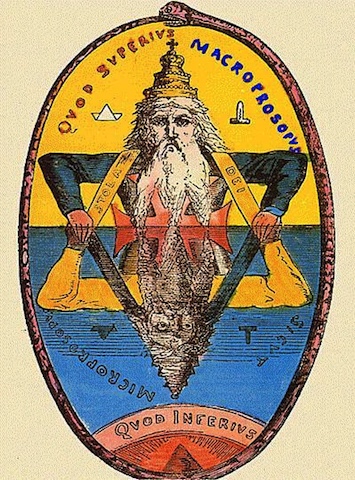
The esoteric doctrine of the unification of opposites is not limited to the Kabbalah. It is, for example, the core of Taoism, whose symbol of the union of Yin and Yang decorates the Korean Flag. It can be shown that also the Israeli flag, carrying the symbol of “the Star of David” is just such a visual expression of the union of opposites, and the most ready illustration of this would be the union of the “earthly Jerusalem” (which is constructed from the ground up) and the “Heavenly City” (constructed, or which flows, from heaven to earth).

I would go further in this Midrash: if the union of the heavenly and of the earthly is to be seen on the flag, then the call for the union of opposites must be found even closer – in our sacred names. It is known that Israel-Jacob represents, in the Kabbalah, just that balance of Hesed and Din, called Tiferet or Rahamim (compassion). Now our insistence to call Jerusalem by the name of “Yerushalayim” with its strange twainess will show – yar’eh – the workings of the concept of “Shalayim” – of that whole (shalem) which is made of the union of two equal and opposite parts joined together. By our daily mention of Jerusalem we constantly evoke, even if unaware, the expectation that she will demonstrate to us this unification, the making of peace and of wholeness out of full conflict.

The reader is likely to comment now that there is no need to go to such an involved Midrash to say that Jerusalem should be “the City of Peace”. It is quite commonplace to say that the “Shalem” of Jerusalem (and forget that confusion “Shalayim”) really means “shalom”, that is, Peace. I would agree, but my point is that this message is coded in the name of Jerusalem, both in that more esoteric way and in another, more blatant way; so much so that we usually refuse to hear the words that come to our ear. These two modes, together, give a prescription for a peace-making process based on Jerusalem. “

MEDITATIONS ON THE NAME OF JERUSALEM

Next Page »

Follow

Get every new post delivered to your Inbox.